| |
 
|
The
Tradition of Hand-Playing (Şelpe) and Playing
Techniques of Baglama in Turkey
Turkish Ministry of Culture, General Directorate for Research and Development of Folk Cultures, Kılıçarslan Press, Ankara, 2000
|
 |
|
Consisting of six chapters, this book is the
result of research done between 1992–1998
and presented as the artists Doctoral Thesis
to the Istanbul Technical University Social
Sciences Institute.
The first chapter explains the work's goal,
scope and methods. In the second chapter,
general information is given on the subject,
including the baglama's historical development
before and in Anatolia, the source of the
hand-playing tradition and its techniques,
as well as important changes and developments
that have taken place in the baglama from
the time it was known as "kopuz",
up to modern times.
|
The third chapter looks at terminology
of hand-playing in Anatolia and explains the
structure and tunings of instruments used with
this technique, and examines traditional melody
types and these melodies' natural polyphony.
The fourth chapter containes studies of hand
techniques, starting with the right hand,
and information on important masters of these
techniques' tradition.
In the fifth chapter, changes and developments
in hand styles are dedscribed, and the bringing
of these techniques to the cities. It goes
on to explain works on the subject subsequent
to this development, and newly-developed strumming
styles and notation techniques.
In the conclusion, the results of the research
are listed in order.
Notice: The new version of the book will
be published which was renewed by Erol Parlak.
For information:
Web Site: www.kultur.gov.tr
Tel: (0312)4311135 - (0312)4303022
Adres: Mithat Pasa Cd. No: 8
P.K: 06420
Yenisehir / ANKARA
|
|
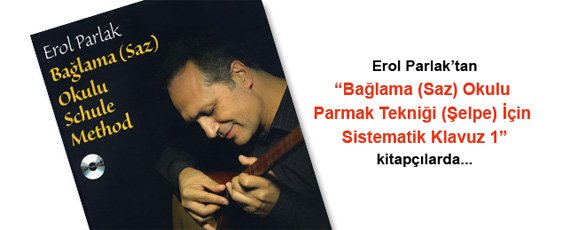
SELPE TECHNIQUE METHOD - 1
Ekin Publications Education Series: 1, Maket Press, Istanbul, 2001; 2nd Edition, 2002
|
This book is the product of nearly ten
years of research, examination and experimentation
by the author, beginning in 1989. In this volume,
the first and only of its kind in the country,
the fundamental theory of selpe (hand-playing
of baglama) as it exists today, thought, technical
characteristics and the notation system, are
taught.
The method consists basically of three chapters.
The first provides general information, and
the second gives a three-stage instruction
with exercises.
The third chapter consists of musical arrangements
of pieces including Serenler, Yayla Yollari,
Göç Yollari, Efsaneyim, Kaytagi,
etc., which put the techniques into practice
with explanations and analysis.
|
|
 |
For Information;
Tel : (0 212) 296 00 90 (0 212) 296 00 72 (0 224) 223 60 16 e-mail : info@erolparlak.com.tr
Europe Contact:
Kazım Öztürk Adres : Mozaik Müzik Merkezi - Basel - İsviçre GSM : +41 79 / 467 23 88 Fax : +41 61 / 273 26 42
|
|
SELPE
TECHNIQUE METHOD - 2
|
 |
|
As the product of experience, experimentation,
discovery and gained over many years, this book
is the continuation and further development
of the teaching presented in its first volume.
The method consists of two basic parts. The
first section gives the logic and methods
behind the work, and explanations of arpeggio
technique and similar subjects; the second
section provides arranged works for analysis
and practice. The notation is a perfected
form of the “çoklu düsünce”
approach, the first steps of which are given
in the exercises section of the first volume,
and developed in the practical application
section. The notation transmits the pieces
exactly, reflecting their melody, rhythms,
nuances and polyphonic structure.
|
In terms of repertoire, priority is again
given to Anatolian melodies, and personal
compositions/arrangements are also included.
These include pieces unique to our country’s
musical heritage such as the Longa examples,
as well as Mozart’s “Alla Turca
(Turkish March),” and Beethoven’s
“Für Elise.”
For Information:
Alfa (Aktüel) Publications
Tel &
Fax : (0 224) 223 60 16
Erol Parlak Müzik Merkezi
Tel
: (0 212) 296 00 90
Tel &
Fax : (0 212) 296 00 72
e-mail
: info@erolparlak.com.tr
|
WORKS IN PROGRESS
Picked Baglama Method - 1
In this work, which has been in progress for
years, Erol Parlak aims to provide nearly all the
accumulated knowledge of picked baglama playing. The
goal is to bring together into a whole the various
tunings, picking patterns, local features and nuances
of different masters' personal styles, as well as
modern-day differences in the baglama which have diverged
and seem to contradict each other.
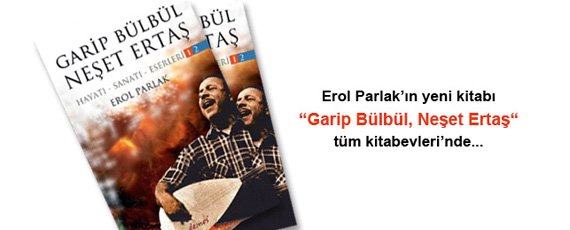
NESET ERTAS — HIS LIFE, ART
AND WORKS
As in the book about Asik Davut Sulari, this
book analyzes and presents, with texts and notation,
the master Neset Ertas's life and personality as an
artist, the fundamental factors comprising this personality,
his works and their qualties, their special features,
and personal style.
Bozlaklar
This work is a revised version of the Erol Parlak's
Master's Thesis by the same title, written in 1987–1990
for the I.T.Ü. Social Sciences Institute, and
is an outcome of the knowledge accumulated from the
time he first started into music.
The thesis has often been used as a source by various
people directly or indirectly working on this subject,
but while some have acknowledged it as they should,
others have failed to list it in their acknowledgements.
For this and similar reasons, by offering at least
the notation portations of "Bozlaklar"
on our site before the book is officially published,
we aim to rescue it from those who, having no original
work, profit by playing the middleman, gathering
others' efforts and marketing them in various areas.
ASIK DAVUT SULARI- HIS LIFE,
ART AND WORKS
In this book, Tercanli Asik Davut
Sulari's life and personality as an artist, the peculiarities
of his works, and the the fundamental reasons for
the artist's work are examined, with texts and notation.
|
|
|
 |
|
|
|
|
|
|