Mail List
Sign up to get informed about updates


Search Engine
Search Criteria
 

Total visitors
since 8th Dec 2004
 
511978


Instruments resembling today's baglama have been found in archaeological excavations of Sumerian and Hittite mounds in Anatolia dating to before Christ, and in ancient Greek works. However, the lack of data to establish their link to recent history has resulted in these relics not being evaluated beyond the mere fact of their appearance there. The oldest existing written sources about instruments resembling the baglama (generally called "lute" in the literature) generally come from Chinese sources and begin in the first century after Christ. For this reason most researchers consider the kopuz, which was brought to Anatolia after the great migrations from Asia, as the origin of the baglama and baglama-type instruments. As much as this view may be supported by its adherents, it is not wise to suppose that as major a cultural region as Anatolia was a vacuum and that this vaccum was filled only at a very late date by means of migrations. What stands out is that when one takes into consideration the variety, richness of playing styles, and broad range of uses of the baglama-type instruments, it is clear that Anatolia is very advanced. Embarking on this subject, which is every bit as complicated as that of where and by whom fire was first discovered, it would be best to evaluate the culture of instrument-making and instrument use of the peoples of Asia and Anatolia together.
There are varying views on the point of origin, as well as the form, of instruments in general and those in the kopuz (baglama) family. One of the most evident is the idea that man, appreciating the sound of the vibrating bowstring on hunting bows, improved upon this knowledge (by the addition of a sound box such as a gourd or other material, the later construction of this out of a single piece of wood, the idea of a sound board, increasing the number of strings, tuning pegs, a fret system, etc.) and arrived at today's instruments. Especially when one examines the instruments in regions such as north Asia, which to a large extent have remained closed, and those in Central and South Asia which have been influenced relatively little by change and devleopment, this view gains the most weight. In these areas, it is very easy observed that instruments are still very close to their prototypes — curved necks, primitive sound boxes/soundboards, strings made of horse hair or gut, etc.; and very old-style playing techniques. Drawing from widely published examples of this theory, Erol Parlak has illustrated it in the drawing below:

The Birth of String Instruments

The kopuz culture is founded on the pre-Islamic belief system of Shamanism, deep evidence of which appears in the traditions and customs of Asia and Anatolia.

Prototip
Kopuz

Mısır
Harpası

Kıl Kopuz

Playing stringed instruments with the hand or an arrow (used as a bow) is one of the oldest of traditions. It has been proved that the prototypes of several saz and baglama prototypes were played with an arrow or by hand.

The evolution of today's many different bowed and non-bowed instruments, including the baglama, has occured over a very long period. Many common elements, such as morphologic structure, playing technique etc., can be seen in the whole body of kopuz-derived instruments belonging to the cultures of Asia and Anatolia.

Saz
(Anadolu)

Saz
(Azerbaycan)

Dutar
(Özbekistan)

Cura Baltasaz
(Anadolu)

Komuz (Kırgızistan)

The word "kopuz" is common to both Asia and Anatolia. In the culture of North Asia, more closed to outside influence, the term kopuz is used alongside onomatopoeic instrument names, that is, names which resemble the sound they describe. Heading south, one meets, along with onomatopoeic terms, the custom of naming instruments according to the number of strings, in Persian: dutar, setar (two-string, three-string), etc. This tradition is present in Anatolia as well; however, the names are all Turkish: ikitelli, üçtelli, etc.

The strings used on the saz and their qualities, are very important. Research has shown that the first material used for saz strings is horse hair. After a long period of using horse hair, gut began to be used, and later, where it was available, silk. The last material to be used was metal. However the use of horse hair has continued throughout every period.

Metal strings brought various changes to the saz in the way of timbre and playing technique. One of the most important of these changes, besides increase in size, the use of a wooden body and hand playing, was the advent of the plectrum (called variously pena, mizrap, or tezene).

In the saz culture of Asia, generally two- or three-string sazes are seen. Although instruments with three or more strings are found in the region, this culture's most characteristic type is two-stringed.

Dutar
(Özbekistan)

Dutar
(Türkmenistan)

Dombra
(Kazakistan)


The great majority of two- or three-stringed sazes in Asia are played with the hand or with a bow, and in those with two strings, the bottom string is the most important playing string. Our research has proved that this approach was present in Anatolia as well and formed the base for the shift to "baglama" tuning.

Though the term "kopuz" gave way to the term "baglama" in around the 17the century, it survives in many different regional names in Anatolia. The reasons for the abandonment of the term "kopuz" are many. The most important of these is the "slander" of the kopuz which started around the 16th century. Because of this the name and the kopuz itself, which had come down through thousands of years, began to be abandoned. This way of thinking, which began in the cities, gained influence in several parts of Anatolia with the exception of the Alevi-Bektasi communities who had placed the music, like the kopuz tradition, on a religious and philosophical foundation. It became a basis of an attitude, which remains to this day, that playing an instrument is a sin, and outside of the Alevi-Bektasi communities which didn't abandon the instrument, the kopuz (baglama) began to be abandoned and to be seen as only an entertainment instrument.

In Anatolia, the term that replaced "kopuz" is generally "Saz" or "Baglama."

Üç Telli Bağlama

Irızva (Ruzba)

Üçtelli Bağlama (Dirmil)

Bağlama
(Neşet Ertaş)


Baltasaz

Cura Baltasaz


The idea of using a plectrum for the kopuz (baglama) began around the 14th century on, with the advent of metal strings, in the Ottoman Palace and its environs. This concept began to be accepted in and after the 17th century, to achieve an increase in volume especially for instruments that were problematic in fasil performance. Under the influence of Ottoman Palace culture, it began crossing over to cities of Anatolia, and from there at last reached the villages.
The adoption of the plectrum by the Anatolian villager, who held tightly to his traditions, came very slowly and with much difficulty. It took almost until after the establishment of the Republic for the poor Anatolian people, for whom metal strings were very difficult to acquire, to move completely to the use of the plectrum. Some, like Asik Veysel, played with his hand but moved easily to playing with a plectrum.

Aşık Veysel Zakir Ismail

Alongside him however were many masters who never adopted the plectrum and continued the tradition of playing only with the hand:

Ramazan Güngör Nesimi Çimen

With the advent of the plectrum, various changes appeared in the saz and the music of Anatolia. After it was adopted, the number of strings on sazes increased, the switch was made to all-metal strings, and wood was used for the face of the instrument. The classification of "plucked instruments" came into being; and some sazes, through an error in terminology, have been placed into this classification even though they are still played with the hand. Along with the concept of the pick, strumming patterns started to take shape, and later, general characteristics of music became bound to these patterns. With time, hand-playing was completely abandoned and the concept of the saz as solely a plucked instrument became established.

After the establishment of the Republic of Turkey, important changes and developments took place. With the founding of the radio and public music arena, baglama production became a business sector, and as a result of this, all kinds of techniques and materials came into use. The Radio had as its goal to unite the music of many regions, each with its own characteristics, into one whole, and as a result, baglamas with additional frets for different semitones became the norm.

Radio Artist Nevzat Ekmekçioğlu with tempered-fretted saz. Click for enlarged photo.

Muzaffer Sarısözen with saz with Si (B) semi-flat fret.
Click for enlarged photo.


The tradition and technique of playing by hand survives chiefly among the Yörük Turkmens in the Teke region of Anatolia, the Alevi-Bektasi communities of central, south and east Anatolia, and, though only to a small extent, among the Turkemens of the Oguzeli region of Gaziantep.

Halil Ibrahim Ünal
(Dirmil, Burdur Region)

Ömer Kanyilmaz
(Dirmil, Burdur Region)

Today, it is becoming more and more clear what the baglama and its culture, color, and playing techniques were, and what they should be. In my opinion, the place to start should be with the first-hand source — this culture's true owners and transmittors — the folk singers, minstrels, poets, local artists, dedes, zakirs etc.; and city musicians and academicians who have knowledge of the facts and have based their works on this foundation. This natural process is after all still taking place in its real setting.

With the baglama, which is moving quickly down the road to worldwide recognition, important developments are taking place in the formation of national tastes and pereferences. But there is a danger that these developments may take form in a monotonous and one-sided way. The inability of true intellectuals to move society ahead in this sense, and market quarrels in the music industry among the fundamental factors in this development. It should not be forgotten that Anatolian culture and the music associated with it is a whole, and anyone with the goal of promoting this whole should take pains to protect, develop, and pass on the future all of its values.

Erol Parlak


Erol Parlak Baglama Quintet's album named "Esik" is available on the market...
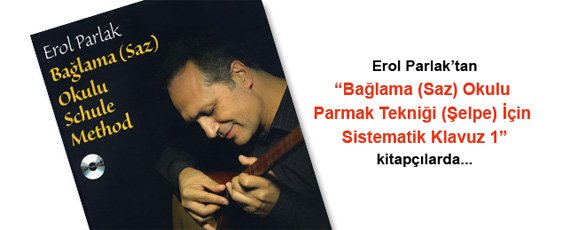
Erol Parlak's new book "Hand (Selpe) Technique Method 2" is available on the market...
Powered by
Guestbook Photo Galley Demo Mp3 Demo Video Press Links Opinions Contact Us